
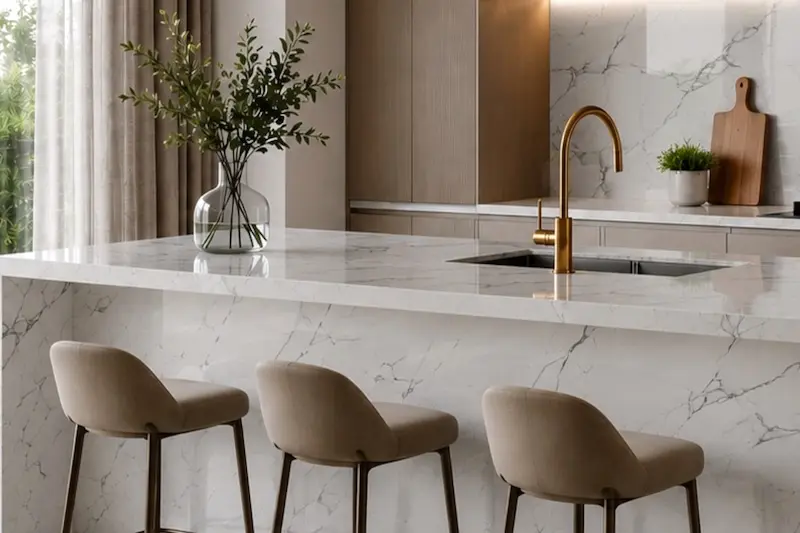
Quartzite kitchen islands are an increasingly popular choice for homeowners nationwide. They combine the veined, marble-like beauty of natural stone with a hardness that holds up to daily family life.
As one of the toughest natural stones available, quartzite takes hot pans, sharp knives and constant use without losing its edge, while its natural veining turns an island into the room’s obvious focal point. This aspect is crucial because the material you choose shapes how the space performs for decades, not just how it looks on day one.
In this article, we explore what makes quartzite kitchen islands so durable, how they look, and what it takes to keep them that way.
What makes quartzite kitchen islands so durable?
Formed under heat and pressure
Quartzite starts life as sandstone. Over millions of years, heat and pressure deep underground recrystallise the quartz grains inside it, turning a soft sedimentary rock into one of the densest natural stones available.
This process is also what separates quartzite from engineered quartz, which is manufactured from crushed stone and resin rather than quarried whole. This makes quartzite close to granite on the hardness scale, but with a depth of colour and veining closer to marble.
Scratch, heat and impact resistance in everyday use
A kitchen island tends to see more traffic than a worktop; it’s where hot pans land straight from the hob, where knives get used without a board, and where kids lean, lift and drop things.
Quartzite’s density gives it strong resistance to scratching and heat, and it holds up to knocks and impacts better than more delicate stones. For a surface that’s also a gathering point for the household, that resilience matters as much as the finish.
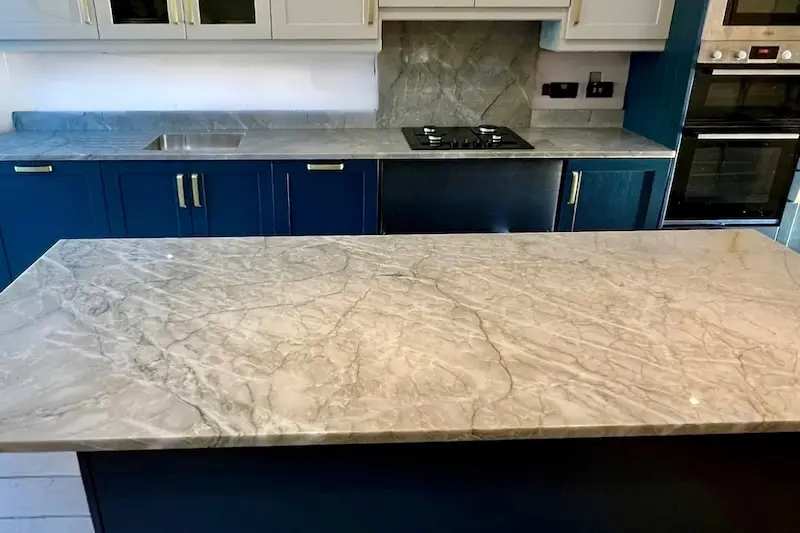
Dolce Natural Quartzite, Co. Dublin
The look and feel of quartzite kitchen islands
Natural veining and colour range
No two quartzite slabs are identical; colours run from warm creams and taupes through to cooler greys and whites, with darker charcoal and black varieties available for a more dramatic island.
Many slabs carry striking veining and a subtle crystalline sparkle that catches the light differently depending on the finish, which is part of why quartzite has become a favourite for anyone looking for a genuine feature piece rather than a uniform surface.
Finishes and pairing with cabinetry
Polished quartzite gives an island a reflective, high-end finish, while honed or leathered options offer a softer, more textured look suited to relaxed or traditional kitchens.
Quartzite also pairs well with contrast: pale, veined slabs stand out against dark or matte cabinetry, while darker quartzite works against natural wood or lighter units.
Either way, the island becomes the room’s defining piece the moment you walk in.
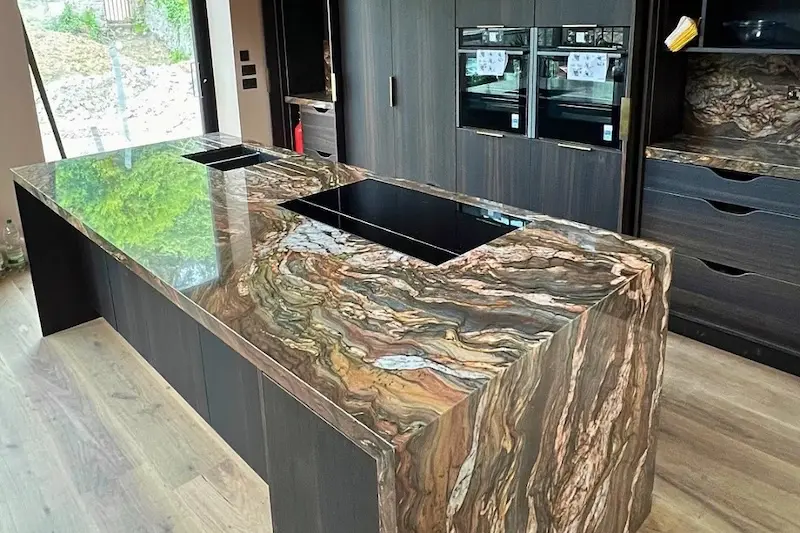
Red Fusion Quartzite, Co. Dublin
Caring for quartzite kitchen islands
Sealing and cleaning
Quartzite is low-maintenance for a natural stone, but it isn’t maintenance-free.
Sealing on installation, and again roughly every 1 to 2 years, protects the surface against staining and keeps it performing at its best. Day to day, a soft cloth, warm water and mild detergent are enough to keep it clean; there’s no need for specialist products or a complicated routine.
What to avoid with a quartzite island
Acidic substances like wine, coffee and citrus juice won’t damage quartzite the way they can etch marble, but they should still be wiped up promptly rather than left to sit.
Harsh chemical cleaners and abrasive scourers can wear down the sealant over time, so it’s worth sticking to gentler products even though the stone itself is tough!
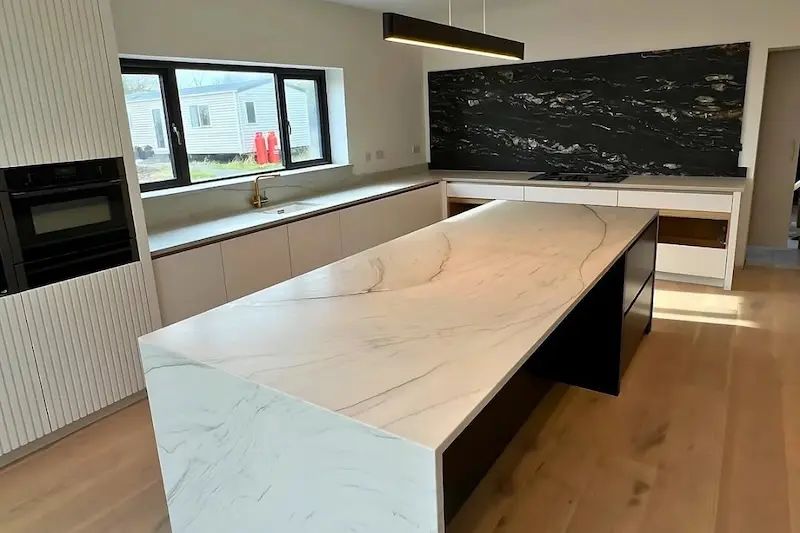
Calacatta Brazil Quartzite, Co. Dublin
Is a quartzite kitchen island right for your kitchen?
Quartzite sits at the higher end of the material range, and that cost reflects its durability and the fact that no two slabs look the same.
It’s heavy, which means professional templating and installation are essential, particularly for an island that needs to be levelled and supported correctly.
For homeowners who want the character of natural stone with less upkeep than marble, and more resilience than most engineered alternatives, quartzite is worth the investment.
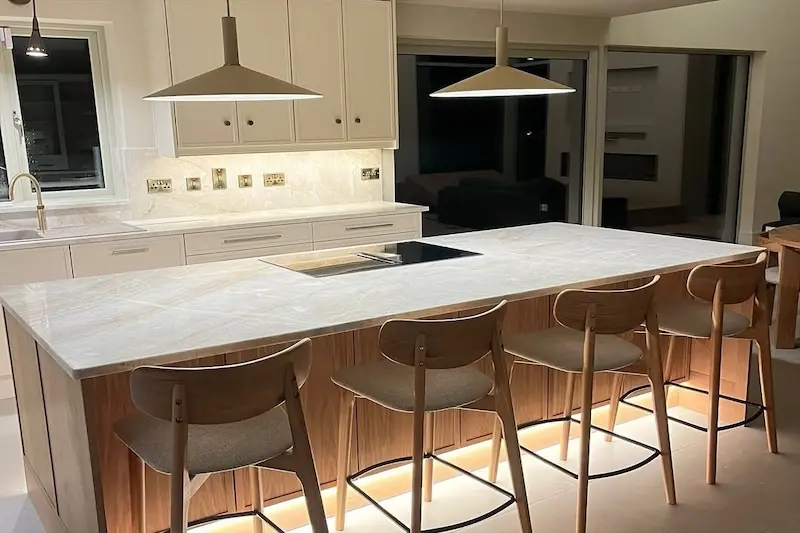
Taj Mahal Quartzite, Cork
Bring your quartzite kitchen island to life with The Stone Gallery
A kitchen island is the heart of the room, whether it’s where the family gathers for breakfast, where guests end up during a dinner party, or where the morning coffee happens before anyone’s properly awake. Getting the material right means it can do all of that and still look like the feature piece it should be.
At The Stone Gallery, our quartzite collection combines that refined, natural beauty with the strength to handle real family life:
- More durable than granite, with strong resistance to heat, scratches and chemical damage
- The look of marble with significantly less upkeep
- No two slabs alike, thanks to quartzite’s natural veining and colour variation
- Eco-friendly and non-toxic
- One of the hardest natural stones available, built for the heaviest daily use an island sees
- A range of finishes, from polished to honed, to suit any kitchen style
- A long-term investment that keeps its beauty and value for decades
So, if you’re ready to explore quartzite kitchen islands, visit our indoor stone showroom, the largest of its kind in Ireland, to see our quartzite slabs in person and start building your dream kitchen today!
Quartzite kitchen islands FAQs
Q: How durable are quartzite kitchen islands?
A: Quartzite is one of the hardest natural stones available, with strong resistance to scratches, impacts and everyday wear, making it well suited to an island that sees constant use.
Q: Do quartzite kitchen islands need to be sealed?
A: Yes, we recommend sealing on installation and then roughly every 1 to 2 years to protect against staining and keep the surface performing at its best.
Q: Can a quartzite kitchen island withstand hot pans and everyday cooking?
A: Yes, quartzite has excellent heat resistance and handles hot pans, active food prep and general kitchen use without warping or damage.
Q: How do quartzite kitchen islands compare to quartz for an island?
A: Quartzite is a natural stone with unique veining and greater heat resistance, while quartz is engineered for colour consistency and needs no sealing. Both are durable; the choice comes down to whether you want natural variation or a uniform finish.
Q: What colours and finishes are available for a quartzite kitchen island?
A: Quartzite ranges from creams and taupes to greys, charcoals and blacks, in polished, honed or leathered finishes, so we can match the island to almost any kitchen style.
Q: Can a quartzite island support an overhang for seating?
A: Yes, with the right support structure. A team of experienced stone masons should assess the design and recommend the correct bracing so an overhang is both functional and safe.
Q: Why choose The Stone Gallery for a quartzite kitchen island?
A: We offer one of Ireland’s largest quartzite selections at our indoor stone showroom, alongside a full-service process from design through to fabrication and installation.